Pixel Shader 2.0 Directx 9.0
Aug 04, 2014 compiled with the latest Intel 9.0 Compiler; linked against the latest Microsoft DirectX SDK (Juni 2005) fixed a shader bug. Pixel shader Vertex shader. If this game is requiring Pixel Shader 2.0, it also likely means your computer does not meet the minimum requirements to run the Windows Aero experience. I am having an issue with directX 9.0c where pixel shader 2.0 works with my graphics card (Nvidia Quadro K1100M) but pixel shader 3.0 does not. More Pixel Shader 2.0 Directx 9.0 videos.
Hi olie,pixel and shader isnt a add on or patch that you can download mate all graphic cards we buy come with certain specifications such as clock speed,memory speed and pixel pielines,all these are what makes up the power of a card pixel and shader model relates to a cards DirectX compliance. DirectX can be divided into two specifications, the Pixel Shader Model, and the Vertex Shader Model. Each model has different hardware requirements, and when you take both into account you can determine the overall DirectX version. Think of this number as a more specific description of the DirectX version. Specifically, what pixel manipulation capabilities it has. This number may directly affect the features that will be available to you in certain games.
.2.jpg "3d Shaders")
How To Stealth Patch Using Abgx360. Here is a list of all the different pixel and shader models. PS2.0 - Came with the original DirectX 9.0 specification. First implemented in the Radeon 9700 Pro. PS2.0a - Usually refers to the extended PS2.0 version supported by nVidia's GeForce FX line. Essentially a quarter of the way to full blown PS3.0. It supported far more instructions and features than the PS2.0 specification required.
PS2.0b - Refers to the shader model supported by the Radeon X700/X8*0 series. Could handle more instructions than PS2.0, but was still behind PS2.0a in instruction limits and features. PS3.0 - Most notably added dynamic flow control making the gpu much more like a general processor (cpu). Also removed the ceiling on most instruction limits entirely and raised other limits significantly. This model is supported by all GeForce 6 Series and higher and all Radeon X1000 series and higher. The code or language used to develope games is called High Level Shader Language High Level Shader Language or High Level Shading Language (HLSL) is a proprietary shading language developed by Microsoft for use with the Microsoft Direct3D API.
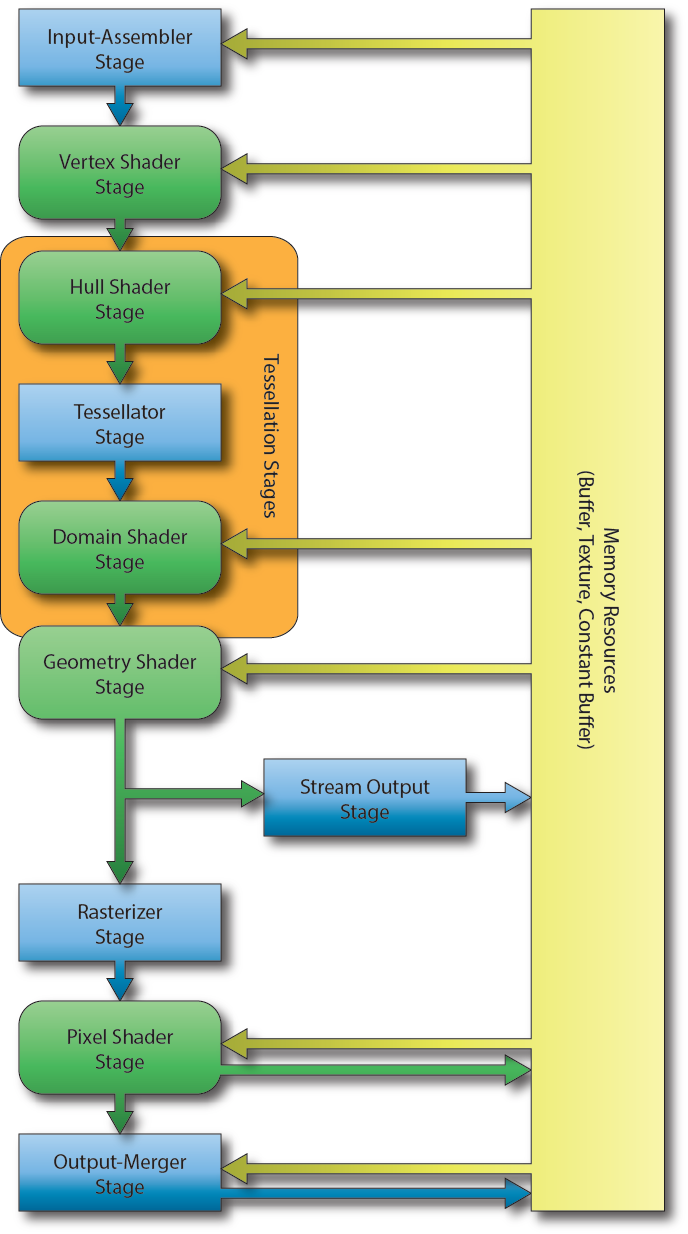
It is analogous to the GLSL shading language used with the OpenGL standard. It is very similar to the NVIDIA Cg shading language. HLSL programs come in three forms, vertex shaders, geometry shaders, and pixel (or fragment) shaders. A vertex shader is executed for each vertex that is submitted by the application, and is primarily responsible for transforming the vertex from object space to view space, generating texture coordinates, and calculating lighting coefficents such as the vertex's tangent, binormal and normal vectors. When a group of vertices (normally 3, to form a triangle) come through the vertex shader, their output position is interpolated to form pixels within its area, this process is known as rasterisation. Each of these pixels comes through the pixel shader, whereby the resultant screen colour is calculated.
Optionally, an application using a Direct3D10 interface and Direct3D10 hardware may also specify a geometry shader. This shader takes as its input the three vertices of a triangle and uses this data to generate (or tessellate) additional triangles, which are each then sent to the rasterizer. This is basically how a pixel and shader model works in a everyday graphic card to get the most from your pixel and shader model 2.0 graphic card download the latest display drivers from either (a.t.i).